
 Home
HomePolytechnic of Milan staff will travel to Asmara, capital of Eritrea and future UNESCO site
 Marilena Dolce
  10/04/17
  0
0  1981
1981 

Courtesy of Gianfredi Pierantoni, Asmara, Eritrea, the Fiat Tagliero petrol station, a symbol of Modernism in the town
Staff from the Polytechnic of Milan will travel to Asmara, capital of Eritrea and future Unesco site, to train technicians for restoration works. A project funded by the European Union.
The Polytechnic of Milan will train technicians for the restoration of Asmara, capital of Eritrea and future Unesco site, during a two-year course for young Eritreans funded by the European Union.
The candidacy of Asmara as Unesco site was presented last November at the Polytechnic in Milan.
On this occasion an international conference was held, chaired by Susanna Bortolotto and Renzo Riboldazzi, “City planning and modern architecture at the test bench of contemporaneity”.
During this meeting Engineer Medhanie Teklemariam, in charge of the Asmara Heritage Project, (AHP) explained why the Eritrean Capital has all the requirements to request protection from the Unesco.
After presenting the candidacy and while waiting for a decision, Susanna Bortolotto, lecturer at the Polytechnic’s Department of Architecture and City Planning Studies, explains EritreaLive her work in Asmara, what is being done and what more will be done.
“For Asmara”, she says “restoration must be of an urban kind, because it’ll be an intervention not only on buildings, but also on public and private green areas, on tree-lined boulevards, on open spaces”.
“In order to achieve this” she continues “we must take into account the people living in the houses to be safeguarded. The objective is to preserve and keep the city first and foremost for its inhabitants, even before being a tourist attraction.”
Asmara has a so far intact beauty, fruit of different styles and expression of a school of thought which affirmed itself at the beginning of the Twentieth Century in Europe.
At the same time when in the Eritrean colony the Modern was being experimented, architecture in Italy was used to reaffirm national identity. Glorious past and tradition had to be the foundations of Italian cities. With the conquest of Ethiopia and the proclamation of the Empire, architecture became an important political tool.
Asmara, though, remained unscathed from fascist excesses. It is not fascist architecture, but the Modern in the heart of Africa which makes it unique.
In the Thirties works were in full swing. Wide boulevards lined by palm trees, marble and mosaic coated buildings, small streets opening up to large squares. Cafes, bars, restaurants, shops, tiled pavements, fountains. All was planned and imagined for the population and commerce.
Large scale private and public buildings were built – none of these by well-known architects, in fact sometimes the author was unknown.
Modernism got up with speed: diesel engines, cableway, cars, airplanes.
It is not surprising, then, that the Fiat Tagliero service station, shaped like an airplane, became an icon of the time.
This significant Modern heritage, which has remained intact for historical reasons, today needs to be safeguarded and restored.
“An urban restoration, though, capable of involving inhabitants, so that they approve the rules that will be established for the preservation of the city”, says Susanna Bortolotto.
“For instance” she continues “a greater control on the use of colours will be necessary by means of a true and proper colour project, as such. If in a given warehouse there is leftover lilac paint, you will not be able to use that colour to paint buildings…”.
And colour is no secondary part in the beauty of Asmara.
“It is plastered with the colours of Africa”, explains the architect, “Asmara does not have white buildings, but earth brown, Pompei red and ocher coloured buildings”.
How did the encounter between the Asmara Heritage Project (AHP) and the Polytechnic of Milan happen?
“The occasion” says the architect “arrived thanks to the Italian Embassy in Asmara, which acted as bridge with Eritrean Institutions.
Then there was the competition, won by the AHP and the Italian University. The European Union, with a funding of 300 thousand euro, approved the project for the training of technicians specialised in the restoration and preservation of the urban heritage. A two-year course to be held in Asmara.”
But that’s not all.
“The funding project has two aims” explains the architect “on the one side, most urgent one is to support the realisation of new urban planning tools and technical norms, to back up the Unesco site. On the other hand, there is the objective to train Eritrean technicians, who will subsequently have to deal with the restoration of the city.”
Therefore, it is very important that architect Bortolotto’s team co-operates with the Eritrean group of Engineer Medhanie Teklemariam. Once the theoretical first year phase has been completed, in fact, the course will continue with practice exercises. There will be a true and proper school workshop.
“The operational group of the Asmara Heritage Project can already implement the excellent expertise and historical research, thanks to the complex archive process of documents in Italian, the census of architecture works, as well as of open spaces, by using the GIS” says architect Bortolotto.
Speaking of these ancient documents in Italian, Mr. Giovanni Fasanella, cultural representative of the Italian Embassy in Asmara, explains EritreaLive that the “ Eritrean group of the Asmara Heritage Project, though good and capable, no longer have many people who can speak Italian well. Therefore, the Centre for Italian Culture in Asmara started a specific Italian language course for them”.
“Engineer Medhanie” says Susanna Bortolotto, “has so far taken census of over four thousand buildings. Each one with its own sheet with volumetric, architectural, physical and technological characteristics at the current state. A fundamental work. For this reason, for the correctness of the method which was adopted, Medhanie was awarded a prize by the Royal Institute of British Architects (RIBA)”.
“It is not easy” continues the architect, “to deal with the restoration of an entire city, because people are living, using, inhabiting the buildings.” “This is why” she explains “it is fundamental to have the recognition and help from the Unesco.”
“It does not often happen” she stresses “that the Unesco decides to preserve a city with a Modernist architecture. More frequently, archeological sites, monumental complexes, historical centres or naturalistic areas are protected.”
“It is difficult to make a masterplan for an entire city” concludes Bortolotto “and to prepare guidelines for the preservation of architectural works of the Modern”
A tough challenge.
“We are hoping” explains Susanna Bortolotto “that the works produced during the two years’ course will become a real project”.
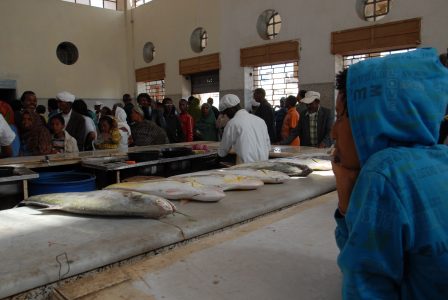
The location identified for this project is the old fish market building.
The architect says “we will study the market, carry out all analytical phases (historical research, survey, diagnostics, material mapping, analysis of damage and structural problems) in preparation for the construction site set-up for the preservation and re-use project. We hope, though, that the project does not remain shut in a drawer, we hope that there is a firm implementing it. That would be great.”
Going down Harnet Avenue, the main street, you get to the markets area of fruit and vegetables, fish and grain. A shady area surrounded by
porticos, which symbolically develops in a cross like shape, with the Great Mosque at the centre.
Once, at the sides of the Mosque there were pathways, which allowed communication between the European zone and the “indigenous” zone, whilst keeping them formally separated.
The first structure of this area dates back to 1902. The following town masterplan by architect Vittorio Cafiero with the close co-operation of engineer Guido Ferrazza, was instead of 1938.
Times when you already had to build keeping into account racial rules.
“The meat, fruit and vegetable market has a central dome, like the Mosque. The building had blue tiles inside, as if wanting to reproduce the sky in a room” explains architect Bortolotto.
The oldest people in Eritrea still remember the transparent dome, which arrived by sea from Italy and was brought from Massawa to Asmara to be placed in the Mosque.
“In the meat and fish sides of the market sale shelves, as you can still see, were of white marble. Electric systems [were] in the period style ceramic, the fridges [were]in the cellars, as they were then” explains the architect.
These are local materials, bricks, Dekamhere granite, glass tiles produced in Asmara, as well as grit and klinker tiles of floors. The only exception being the column capitals in the porticos, made of Carrara marble.
“It is not an everyday occurrence” stresses architect Bortolotto referring to her commitment, “to work on an entire city”.
“A city” continues “where everything, which is linked to the colonization phase is considered part of Eritrean identity. And I stress that Eritreans are first and foremost aware of the value of its protection and preservation.”
For this reason the beauty, pride of the city, must be known by all, above all by the youngest people.
“In particular” explains the architect “school age children could visit, learn about and rediscover their own town, establishing different routes; an open air route; of monuments, residences, cinemas, but also about interior design and finishes. A simple way to give training and education.”
The two-year course held by the Polytechnic of Milan, as well as the Unesco candidacy could become, for Eritrean young people, an important work opportunity. At the moment about 50 young people will be involved. The hope, though, is that the commitment for the preservation and restoration of the city may see an increase in their number.
“Training and acquisition of new skills are the tool” says architect Bortolotto “for young Eritrean technicians to find an occupation, in the near future, in the preservation of their city’s heritage, without necessarily relying on external interventions.”
“The Asmara Heritage Project is taking all necessary steps to reach the goal, including the organisation of an international conference in Asmara.”
“I would like that” she concludes “in 2018, at the end of this project course, there could be an event in Italy, too, at the Milan Polytechnic, to assess the results of the work carried out in the city of Asmara, a complex reality, which is very fascinating and yet little known.”
Meanwhile we make the appointment, to meet them next year in Milan.
Marilena Dolce
@EritreaLive

Condividi su:


Lascia un commento